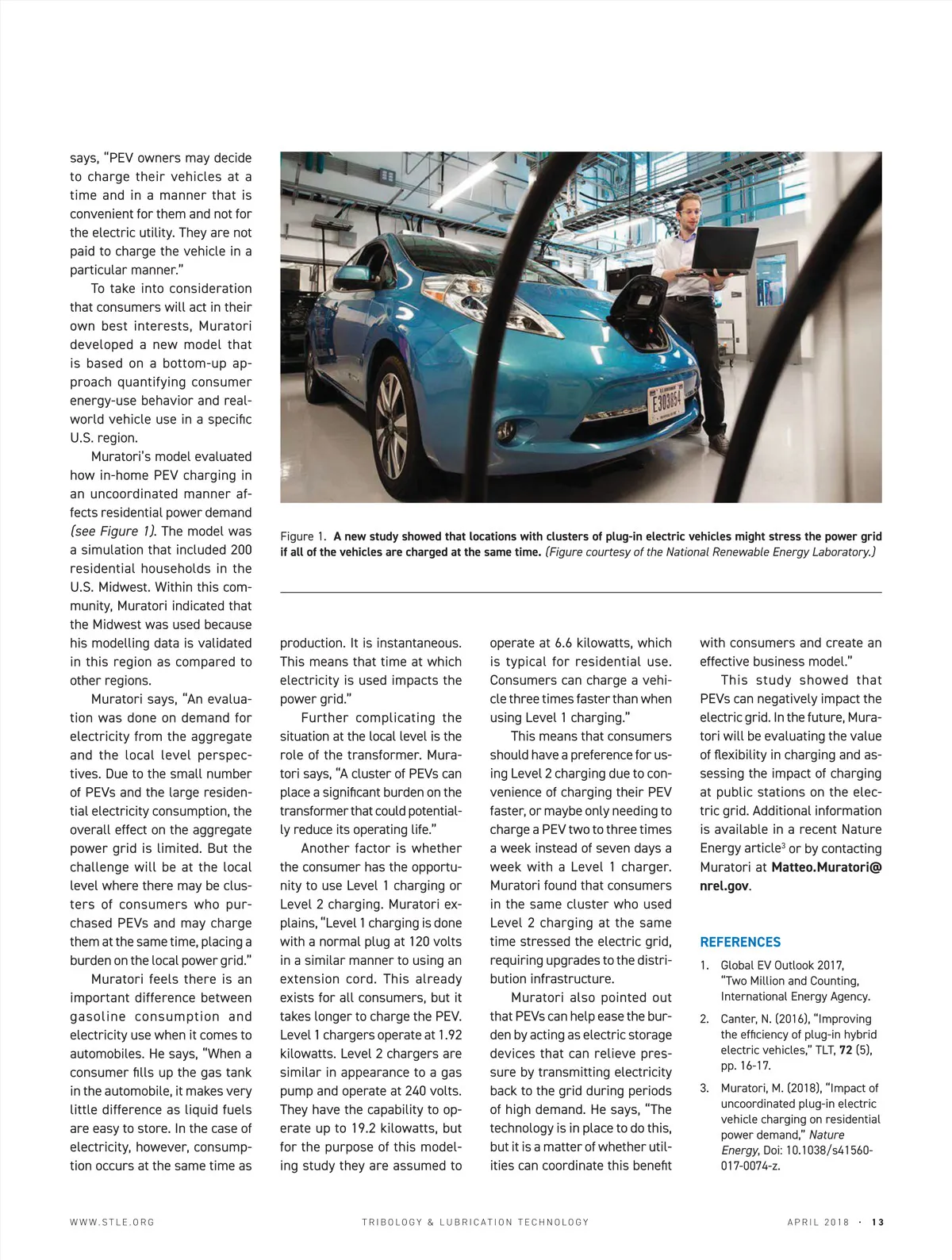
TECH BEAT How will the growing use of plug-in electric vehicles affect the power grid? A new model based on a bottom-up approach quantifies consumer energy-use behavior and real-world vehicle usage. By Dr. Neil Canter Contributing Editor KEY CONCEPTS A new study suggests the increasing use of plug-in electric vehicles might negatively affect the power grid. The overall effect of more plug-in electric vehicles on the aggregate power grid is limited. If local clusters of consumers charge their plug-in electric vehicles at the same time, the study concludes that the power grid will be stressed. Demand for plug-in electric vehicles (PEVs) is growing globally as regulations are motivating automotive OEMs and consumers to move away from cars powered by internal combustion engines. In 2016 the number of PEVs in use globally was greater than two million vehicles, an approximately 60% increase from 2015. 1 A challenge facing research-ers is better understanding how electric vehicle performance can be optimized. In a previous TLT article, a reinforcement-learning energy management system model was developed that en-ables plug-in-hybrid electric vehicles to more efficiently oper-ate by constantly learning about the environment in which the automobile is traveling. 2 A trial conducted on a highway reduced fuel consumption by 12%. As PEV use grows, one con-cern that must be addressed is: How will this affect the power grid? The nightmare scenario is consumers will all decide to plug in their PEVs at the same time to recharge their batteries. This growing demand may place too much demand on the power grid leading to its collapse in the worst-case scenario. Growth in the use of PEVs is adding further complexity for electric utilities in figuring out how to manage power generation, transmission and distribution. Most past efforts to model the power demand originating from PEVs had limitations. Dr. Matteo Muratori, transportation and energy systems engineer at the National Renewable Energy Laboratory in Golden, Colo., says, “Previous models assessing how PEVs affected the electric Growth in the use of PEVs is adding further complex-ity for electric utilities in figuring out how to manage power generation, transmission and distribution. grid assumed that consumers charged their vehicles in a smart manner, which was convenient for the electric utility.” Muratori believes that there is another side to the story. He © Can Stock Photo / dashark 12 • APRIL 2018 TRIBOLOGY & LUBRICATION TECHNOLOGY WWW.STLE.ORG
Tribology and Lubrication Technology April 2018: Page 12