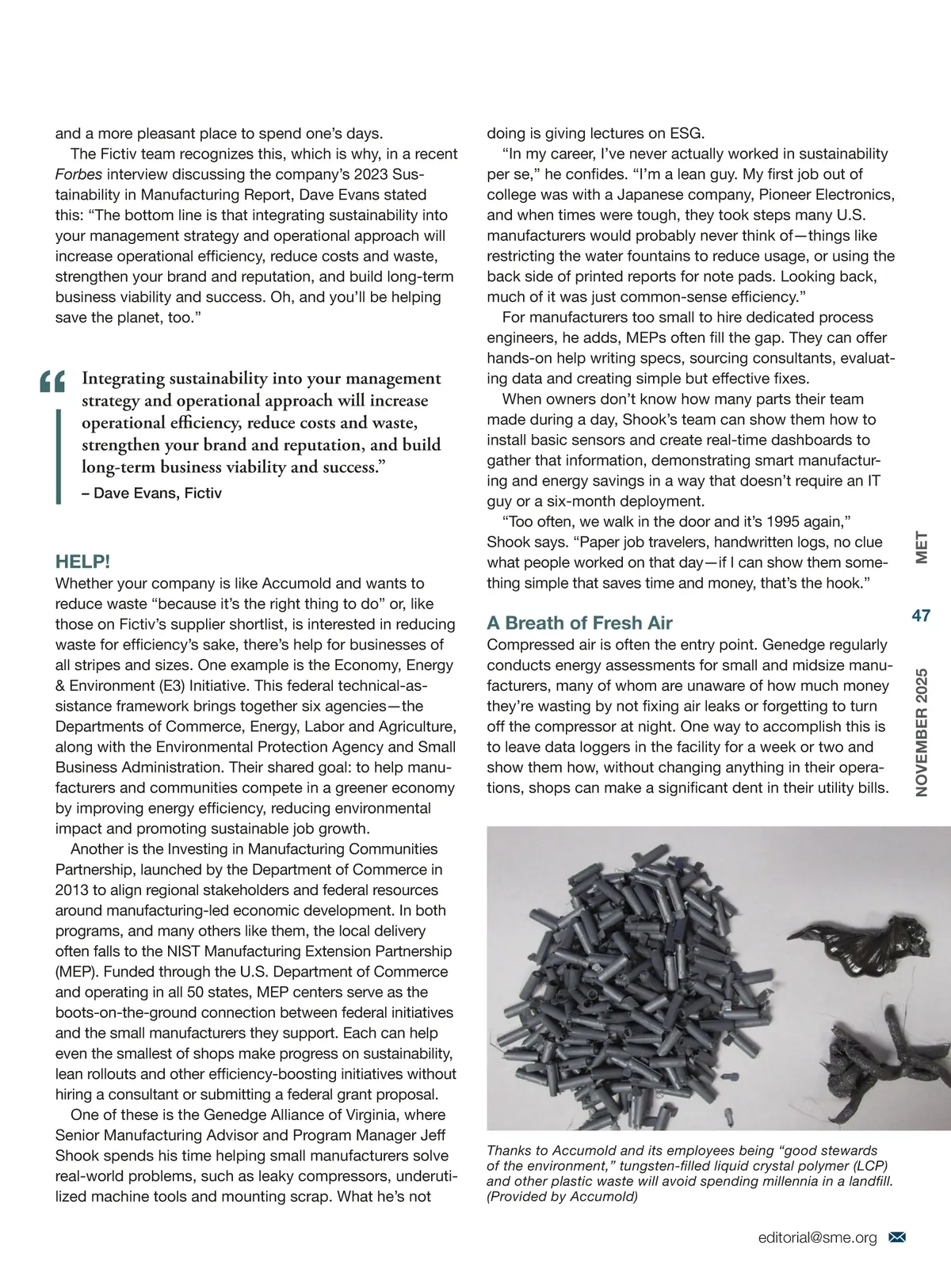
and a more pleasant place to spend one’s days. The Fictiv team recognizes this, which is why, in a recent Forbes interview discussing the company’s 2023 Sus-tainability in Manufacturing Report, Dave Evans stated this: “The bottom line is that integrating sustainability into your management strategy and operational approach will increase operational efficiency, reduce costs and waste, strengthen your brand and reputation, and build long-term business viability and success. Oh, and you’ll be helping save the planet, too.” Integrating sustainability into your management strategy and operational approach will increase operational efficiency, reduce costs and waste, strengthen your brand and reputation, and build long-term business viability and success.” – Dave Evans, Fictiv HELP! Whether your company is like Accumold and wants to reduce waste “because it’s the right thing to do” or, like those on Fictiv’s supplier shortlist, is interested in reducing waste for efficiency’s sake, there’s help for businesses of all stripes and sizes. One example is the Economy, Energy & Environment (E3) Initiative. This federal technical-as-sistance framework brings together six agencies—the Departments of Commerce, Energy, Labor and Agriculture, along with the Environmental Protection Agency and Small Business Administration. Their shared goal: to help manu-facturers and communities compete in a greener economy by improving energy efficiency, reducing environmental impact and promoting sustainable job growth. Another is the Investing in Manufacturing Communities Partnership, launched by the Department of Commerce in 2013 to align regional stakeholders and federal resources around manufacturing-led economic development. In both programs, and many others like them, the local delivery often falls to the NIST Manufacturing Extension Partnership (MEP). Funded through the U.S. Department of Commerce and operating in all 50 states, MEP centers serve as the boots-on-the-ground connection between federal initiatives and the small manufacturers they support. Each can help even the smallest of shops make progress on sustainability, lean rollouts and other efficiency-boosting initiatives without hiring a consultant or submitting a federal grant proposal. One of these is the Genedge Alliance of Virginia, where Senior Manufacturing Advisor and Program Manager Jeff Shook spends his time helping small manufacturers solve real-world problems, such as leaky compressors, underuti-lized machine tools and mounting scrap. What he’s not doing is giving lectures on ESG. “In my career, I’ve never actually worked in sustainability per se,” he confides. “I’m a lean guy. My first job out of college was with a Japanese company, Pioneer Electronics, and when times were tough, they took steps many U.S. manufacturers would probably never think of—things like restricting the water fountains to reduce usage, or using the back side of printed reports for note pads. Looking back, much of it was just common-sense efficiency.” For manufacturers too small to hire dedicated process engineers, he adds, MEPs often fill the gap. They can offer hands-on help writing specs, sourcing consultants, evaluat-ing data and creating simple but effective fixes. When owners don’t know how many parts their team made during a day, Shook’s team can show them how to install basic sensors and create real-time dashboards to gather that information, demonstrating smart manufactur-ing and energy savings in a way that doesn’t require an IT guy or a six-month deployment. “Too often, we walk in the door and it’s 1995 again,” Shook says. “Paper job travelers, handwritten logs, no clue what people worked on that day—if I can show them some-thing simple that saves time and money, that’s the hook.” A Breath of Fresh Air Compressed air is often the entry point. Genedge regularly conducts energy assessments for small and midsize manu-facturers, many of whom are unaware of how much money they’re wasting by not fixing air leaks or forgetting to turn off the compressor at night. One way to accomplish this is to leave data loggers in the facility for a week or two and show them how, without changing anything in their opera-tions, shops can make a significant dent in their utility bills. 47 Thanks to Accumold and its employees being “good stewards of the environment,” tungsten-filled liquid crystal polymer (LCP) and other plastic waste will avoid spending millennia in a landfill. (Provided by Accumold) editorial@sme.org NOVEMBER 2025 MET
Manufacturing Engineering November 2025: Page 47