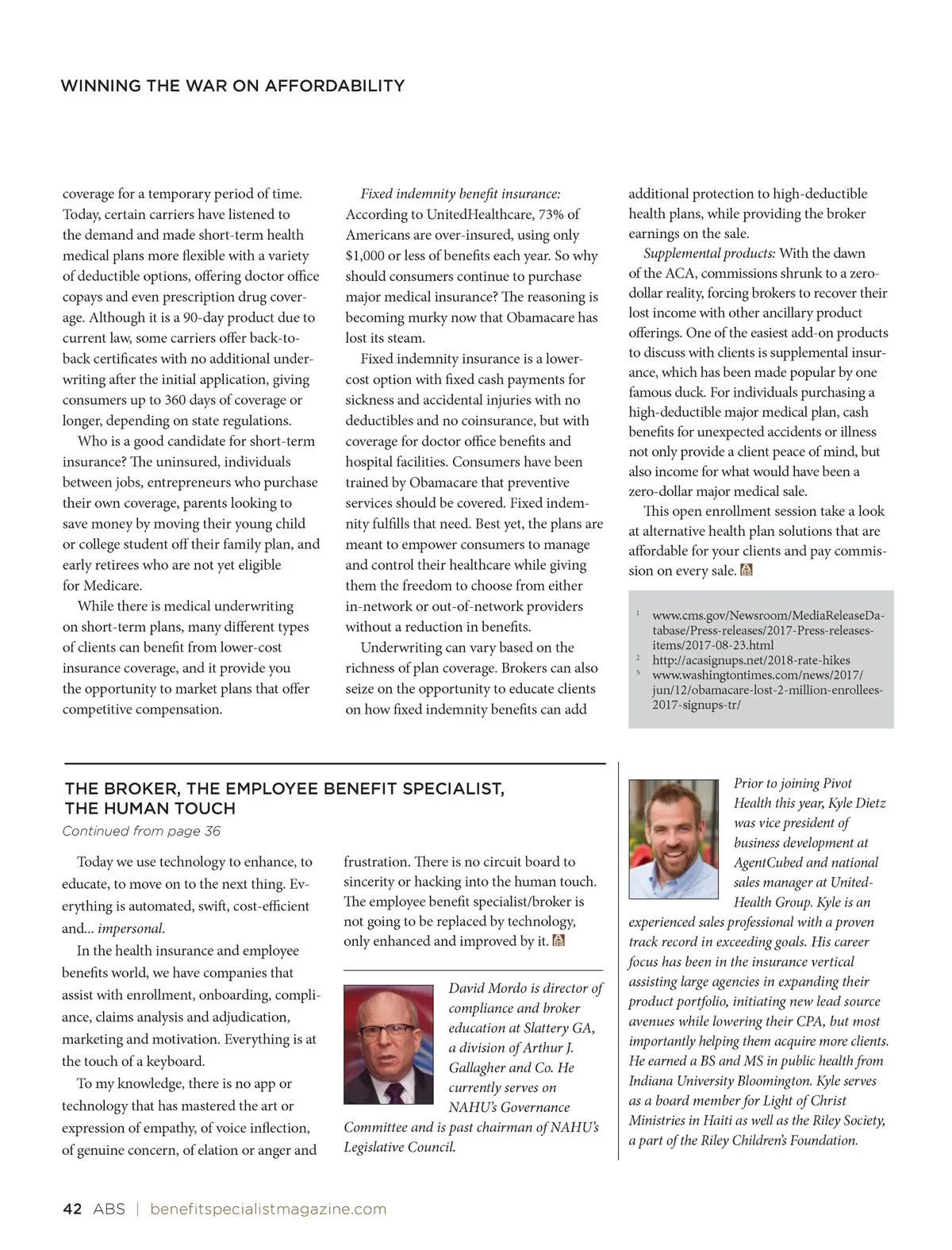
WINNING THE WAR ON AFFORDABILITY coverage for a temporary period of time. Today, certain carriers have listened to the demand and made short-term health medical plans more fl exible with a variety of deductible options, off ering doctor offi ce copays and even prescription drug cover-age. Although it is a 90-day product due to current law, some carriers off er back-to-back certifi cates with no additional under-writing aft er the initial application, giving consumers up to 360 days of coverage or longer, depending on state regulations. Who is a good candidate for short-term insurance? Th e uninsured, individuals between jobs, entrepreneurs who purchase their own coverage, parents looking to save money by moving their young child or college student off their family plan, and early retirees who are not yet eligible for Medicare. While there is medical underwriting on short-term plans, many diff erent types of clients can benefi t from lower-cost insurance coverage, and it provide you the opportunity to market plans that off er competitive compensation. Fixed indemnity benefi t insurance: According to UnitedHealthcare, 73% of Americans are over-insured, using only $1,000 or less of benefi ts each year. So why should consumers continue to purchase major medical insurance? Th e reasoning is becoming murky now that Obamacare has lost its steam. Fixed indemnity insurance is a lower-cost option with fi xed cash payments for sickness and accidental injuries with no deductibles and no coinsurance, but with coverage for doctor offi ce benefi ts and hospital facilities. Consumers have been trained by Obamacare that preventive services should be covered. Fixed indem-nity fulfi lls that need. Best yet, the plans are meant to empower consumers to manage and control their healthcare while giving them the freedom to choose from either in-network or out-of-network providers without a reduction in benefi ts. Underwriting can vary based on the richness of plan coverage. Brokers can also seize on the opportunity to educate clients on how fi xed indemnity benefi ts can add additional protection to high-deductible health plans, while providing the broker earnings on the sale. Supplemental products: With the dawn of the ACA, commissions shrunk to a zero-dollar reality, forcing brokers to recover their lost income with other ancillary product off erings. One of the easiest add-on products to discuss with clients is supplemental insur-ance, which has been made popular by one famous duck. For individuals purchasing a high-deductible major medical plan, cash benefi ts for unexpected accidents or illness not only provide a client peace of mind, but also income for what would have been a zero-dollar major medical sale. Th is open enrollment session take a look at alternative health plan solutions that are aff ordable for your clients and pay commis-sion on every sale. 1 2 3 www.cms.gov/Newsroom/MediaReleaseDa-tabase/Press-releases/2017-Press-releases-items/2017-08-23.html http://acasignups.net/2018-rate-hikes www.washingtontimes.com/news/2017/ jun/12/obamacare-lost-2-million-enrollees-2017-signups-tr/ THE BROKER, THE EMPLOYEE BENEFIT SPECIALIST, THE HUMAN TOUCH Continued from page 36 Today we use technology to enhance, to educate, to move on to the next thing. Ev-erything is automated, swift , cost-effi cient and... impersonal . In the health insurance and employee benefi ts world, we have companies that assist with enrollment, onboarding, compli-ance, claims analysis and adjudication, marketing and motivation. Everything is at the touch of a keyboard. To my knowledge, there is no app or technology that has mastered the art or expression of empathy, of voice infl ection, of genuine concern, of elation or anger and frustration. Th ere is no circuit board to sincerity or hacking into the human touch. Th e employee benefi t specialist/broker is not going to be replaced by technology, only enhanced and improved by it. David Mordo is director of compliance and broker education at Slattery GA, a division of Arthur J. Gallagher and Co. He currently serves on NAHU’s Governance Committee and is past chairman of NAHU’s Legislative Council. Prior to joining Pivot Health this year, Kyle Dietz was vice president of business development at AgentCubed and national sales manager at United-Health Group. Kyle is an experienced sales professional with a proven track record in exceeding goals. His career focus has been in the insurance vertical assisting large agencies in expanding their product portfolio, initiating new lead source avenues while lowering their CPA, but most importantly helping them acquire more clients. He earned a BS and MS in public health from Indiana University Bloomington. Kyle serves as a board member for Light of Christ Ministries in Haiti as well as the Riley Society, a part of the Riley Children’s Foundation. 42 ABS | benefitspecialistmagazine.com
America's Benefit Specialist October 2017: Page 42