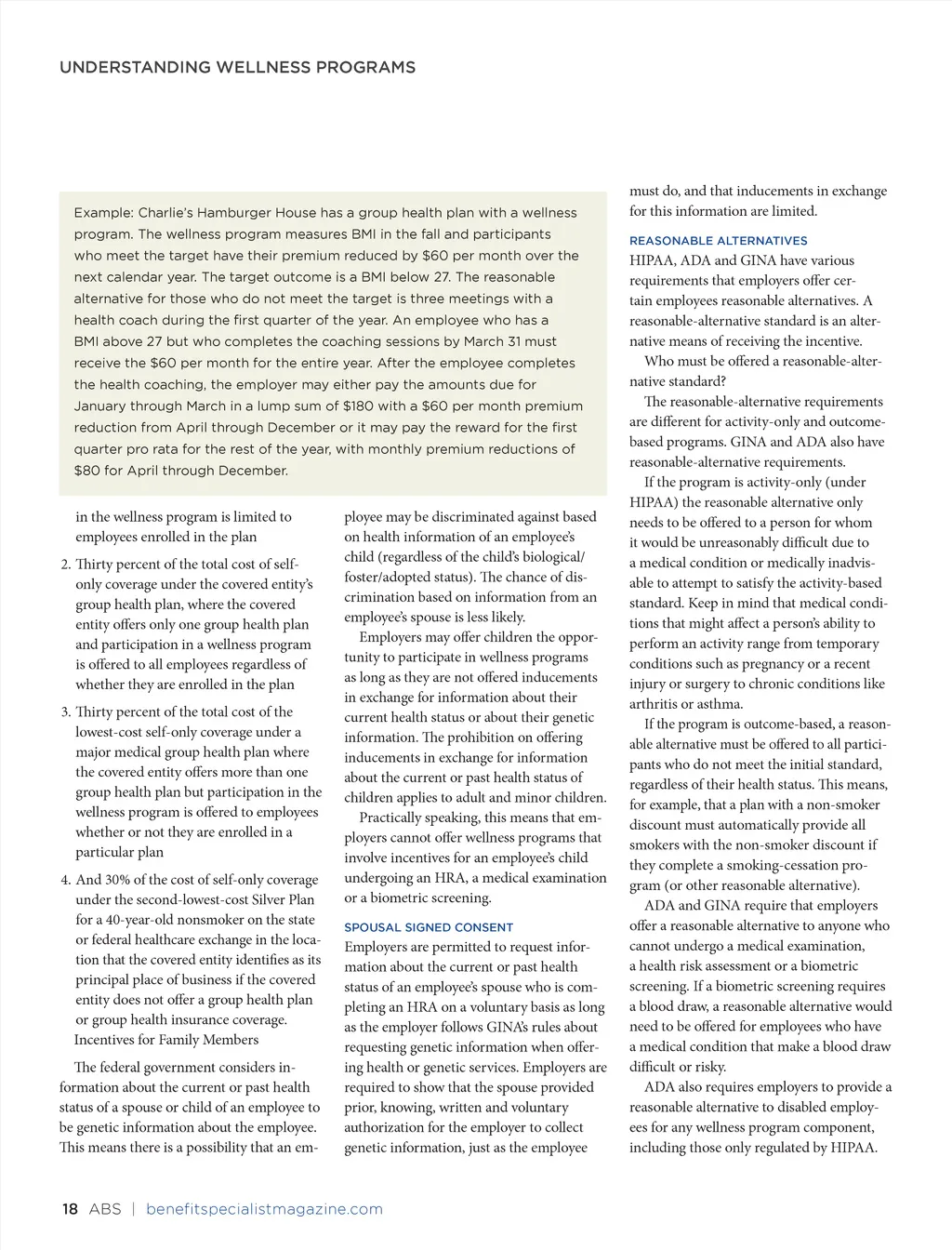
UNDERSTANDING WELLNESS PROGRAMS Example: Charlie’s Hamburger House has a group health plan with a wellness program. The wellness program measures BMI in the fall and participants who meet the target have their premium reduced by $60 per month over the next calendar year. The target outcome is a BMI below 27. The reasonable alternative for those who do not meet the target is three meetings with a health coach during the first quarter of the year. An employee who has a BMI above 27 but who completes the coaching sessions by March 31 must receive the $60 per month for the entire year. After the employee completes the health coaching, the employer may either pay the amounts due for January through March in a lump sum of $180 with a $60 per month premium reduction from April through December or it may pay the reward for the first quarter pro rata for the rest of the year, with monthly premium reductions of $80 for April through December. must do, and that inducements in exchange for this information are limited. REASONABLE ALTERNATIVES in the wellness program is limited to employees enrolled in the plan 2. Thirty percent of the total cost of self-only coverage under the covered entity’s group health plan, where the covered entity offers only one group health plan and participation in a wellness program is offered to all employees regardless of whether they are enrolled in the plan 3. Thirty percent of the total cost of the lowest-cost self-only coverage under a major medical group health plan where the covered entity offers more than one group health plan but participation in the wellness program is offered to employees whether or not they are enrolled in a particular plan 4. And 30% of the cost of self-only coverage under the second-lowest-cost Silver Plan for a 40-year-old nonsmoker on the state or federal healthcare exchange in the loca-tion that the covered entity identifies as its principal place of business if the covered entity does not offer a group health plan or group health insurance coverage. Incentives for Family Members The federal government considers in-formation about the current or past health status of a spouse or child of an employee to be genetic information about the employee. This means there is a possibility that an em-ployee may be discriminated against based on health information of an employee’s child (regardless of the child’s biological/ foster/adopted status). The chance of dis-crimination based on information from an employee’s spouse is less likely. Employers may offer children the oppor-tunity to participate in wellness programs as long as they are not offered inducements in exchange for information about their current health status or about their genetic information. The prohibition on offering inducements in exchange for information about the current or past health status of children applies to adult and minor children. Practically speaking, this means that em-ployers cannot offer wellness programs that involve incentives for an employee’s child undergoing an HRA, a medical examination or a biometric screening. SPOUSAL SIGNED CONSENT Employers are permitted to request infor-mation about the current or past health status of an employee’s spouse who is com-pleting an HRA on a voluntary basis as long as the employer follows GINA’s rules about requesting genetic information when offer-ing health or genetic services. Employers are required to show that the spouse provided prior, knowing, written and voluntary authorization for the employer to collect genetic information, just as the employee HIPAA, ADA and GINA have various requirements that employers offer cer-tain employees reasonable alternatives. A reasonable-alternative standard is an alter-native means of receiving the incentive. Who must be offered a reasonable-alter-native standard? The reasonable-alternative requirements are different for activity-only and outcome-based programs. GINA and ADA also have reasonable-alternative requirements. If the program is activity-only (under HIPAA) the reasonable alternative only needs to be offered to a person for whom it would be unreasonably difficult due to a medical condition or medically inadvis-able to attempt to satisfy the activity-based standard. Keep in mind that medical condi-tions that might affect a person’s ability to perform an activity range from temporary conditions such as pregnancy or a recent injury or surgery to chronic conditions like arthritis or asthma. If the program is outcome-based, a reason-able alternative must be offered to all partici-pants who do not meet the initial standard, regardless of their health status. This means, for example, that a plan with a non-smoker discount must automatically provide all smokers with the non-smoker discount if they complete a smoking-cessation pro-gram (or other reasonable alternative). ADA and GINA require that employers offer a reasonable alternative to anyone who cannot undergo a medical examination, a health risk assessment or a biometric screening. If a biometric screening requires a blood draw, a reasonable alternative would need to be offered for employees who have a medical condition that make a blood draw difficult or risky. ADA also requires employers to provide a reasonable alternative to disabled employ-ees for any wellness program component, including those only regulated by HIPAA. 18 ABS | benefitspecialistmagazine.com
America's Benefit Specialist April 2017: Page 18